Showing posts with label Federal Reserve. Show all posts

Saturday, December 29, 2012

The Damage Caused By the Fed's Zero Interest Rate Policy (ZIRP)

Accounting for various inflation measures, the target and daily effective Fed Funds interest rate has been negative since 2009. The Fed has reiterated this so-called "zero interest rate policy" or ZIRP, indefinitely, and additionally has tied further monetary easing measures via bond and asset purchases not only to inflation, but to unemployment, regardless of the lack of evidence that such monetary measures positively affect growth leading to less unemployment. Rates on Treasury Inflation Protected Securities (TIPS) recently hit a record low yield to maturity of -1.496% on 4-year, 4-month issues, forcing the obvious question: Who would buy these things? Evidently, investors are willing to accept getting paid back less than the principal loan at maturity on the expectation that regular payments tied to the government's understated consumer price index (CPI) inflation measure will make up for the negative yield to maturity over the life of the loan - the auction was relatively strong, with a 2.7 bid-to-cover. The likely outcome is that investors will barely break even or lose money, given that inflation and risk will be running higher than expected or as sold to investors.

Creditors and savers lose money in this ZIRP environment, while debtors gain. That has been the goal of the Fed all along, to manipulate the cost of money so as to provide a bailout to all of those debtors, deleveraging or not. The accepted term for this ruse is appropriate: Financial Repression. What the Fed does not admit to is that this practice has significantly skewed the risk-reward for investors willing to lend money, and has created systemic risks tied to the interest rate markets. Both of these side effects have an impact on private investment, and by extension, real economic growth. On a basic level, investors willing to lend money want to see the level of risk tied to the potential reward, as set by market pricing, not as manipulated by a cartel. If that reward has a manipulated ceiling, or has a higher than expected probability of losses (negative reward) due to interest rate dislocations, defaults or other risks not priced in, then investors will shy away from taking any risk at all: they simply will hoard their capital and not lend. We've seen strong evidence of that in the last 3-4 years, as a result of an accommodative Fed feeding overextended debtors looking for a cushy reprieve from the housing and credit market bubbles the Fed helped to create.

Much talk has been made recently about how and when the Fed will proceed to raise interest rates and unwind its growing balance sheet of Treasury and Agency (MBS) securities, bought to keep interest rates artificially low for government borrowing, public mortgage financing and debtor refinancing. Existentially, there is a threat that interest rates could rise without a Fed change in ZIRP: the interest rate markets could dislocate rates higher to more accurately reflect risks. The danger is that dislocation could be severe and lead to significant losses in bonds and in interest rate sensitive securities and derivatives, including currencies. It has been my conviction that the Fed has not quantified this "Black Swan" event or series of events. The severity is potentially very high given the collaterized nature of Treasury and Agency securities within the global financial system, including the repurchase agreement (repo) markets. Rated securities used as accepted collateral experiencing significant sharp losses will have a systemic effect across the system. Critics answer this existential threat by stating that the Fed could simply flood the system with liquidity (printed money), in the magnitude and durations needed to restore stability. This is a fallacy; as I have pointed out in other essays, the Fed is an endogenous (not exogenous) entity, not unlike a large hedge fund, and the belief that it could perpetually print money to save its "system" is as wrong-headed as believing in perpetual motion machines. Trust is not infinite, and Federal Reserve Notes and Treasurys carry risks tied to trust.

Creditors and savers (investors) held hostage by the financial repression of ZIRP have little wiggle room other than to continue to push for changes in the powers carried by the Federal Reserve. Those powers are sold to all of us as a common good, when in fact it has led to an involuntary wealth redistribution scheme, a tax meant to benefit government and politically recruited debtors, with a leveler outcome of stagnant or negative real growth. At its worst, these powers have throttled systemic risks and will continue to do so, instead of unshackling markets and investors to allow for markets to set price levels and risk-reward curves based on supply and demand, and not on politically-motivated cartel manipulations.


Wednesday, November 9, 2011

Repo Markets and Financial Instability

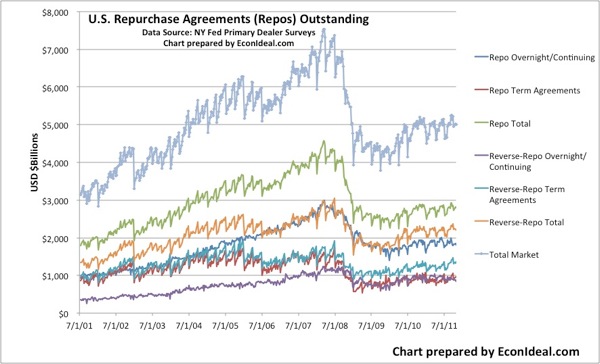
NYFed PriDealerRepo Jul 01 Nov 11

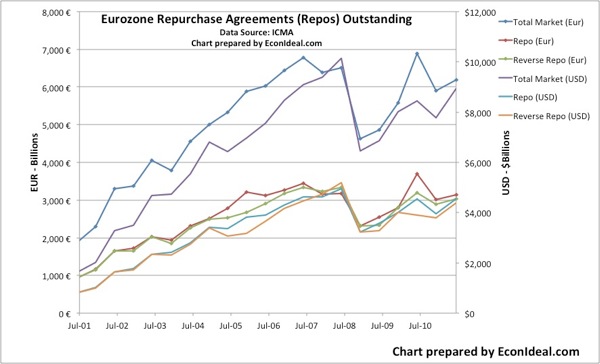
ICMA EurRepoSurvey Jun 01 Jun 11

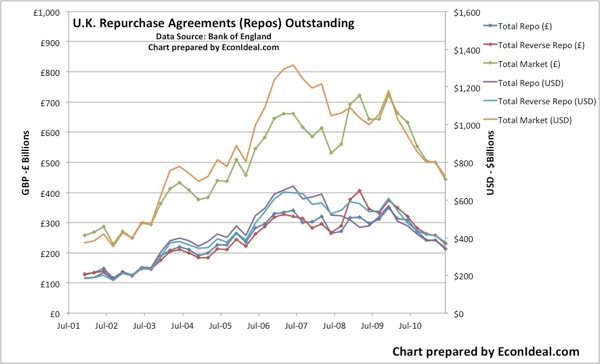
BoE repo Dec 01 Jun 11

SIFMA global cdo issuance

SIFMA MBSABS Issuance

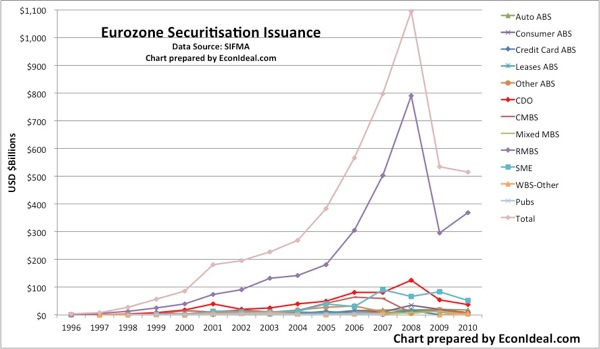
SIFMA Eur Securitisation Issuance

The repo markets are fueling the fires again.

Repurchase agreements ("repos") are the sale of securities combined with an agreement for the seller to buy back the securities at a later date, or a cash financing transaction combined with a forward contract. The duration of the agreement can be overnight, term or open. They are heavily used by investment firms to obtain short-term financing that can be rolled over; common financing aims are for longer-maturity, higher-yielding securities to juice the yield spread. Collateral for repo trades include sovereign debt (e.g., Treasuries), agency debt (e.g., Fannie/Freddie or GSE debt), or mortgage-backed securities (MBS). The Federal Reserve also uses repos to inject or withdraw money into/from bank reserves and the money supply, with Treasuries serving as usual collateral.

As the curves above show, the repo market size just among U.S. Primary Dealers had grown geometrically in the last decade, until choking following the 2007-8 credit markets seizure. It is worthwhile to note that the growth and decline of these markets correlates with the growth and decline of collateralized debt obligation (CDO) issuance, the same asset and mortgage-backed derivative security that provided a significant contribution to the counterparty risks leading to the credit markets seizure. CDOs were a structured hodgepodge of good and bad mortgage and asset-backed debt, and given a AAA rating from credit rating agencies, making them eligible as collateral for repo transactions, and attractive for their yield. When default rates picked up in 2006-7, the values of CDOs plummeted, and triggered a margin call nightmare that eventually doomed both Bear Stearns and Lehman. The fallout also affected AIG, who sold cheap CDO insurance in the form of credit default swaps (CDS) to CDO buyers, without recognizing the risks should those CDOs implode. The repo markets made most of this "Ponzi finance" of CDOs possible.

It may not be a surprise then that the recent failure of yet another large brokerage firm and primary dealer (MF Global) involved a sizable ($7.6B in March 2011) repo trade with European sovereign debt as collateral. Though MF Global structured the trade such that the maturity of the repo equaled the duration of the European bonds pledged as collateral, thereby seemingly reducing its duration mismatch risk, the firm off-loaded the collateral from its balance sheet as part of the accounting for the repo sale, and in doing so summarily avoided capital cushions to cover shortfalls should that debt lose value until maturity. As the Euro debt crisis heated up this fall, MF Global started getting a barrage of margin calls, then credit downgrades, and then more margin calls. It failed to survive this liquidity thrashing, seeking bankruptcy protection on Halloween. Lehman succumbed to similar fate, and has been accused of employing repo transactions as accounting maneuvers to manipulate its financial reports and leverage, using the funds from repo sales to temporarily pay down debt before repurchasing the collateral ("Repo 105").

To be sure, many repo transactions are used responsibly and legitimately, just as firms responsibly and legitimately use interest rate swaps to hedge interest rate risk. The problem arises when the underlying collateral of the repo trade sharply loses value, and the seller counterparty doesn't have enough capital to survive margin calls and credit downgrades.

The financial instability caused by the exploitation of the repo markets to finance the debt market growth cannot be overlooked, though regulators (Federal Reserve, SEC, et al.) have consistently ignored this major weak point. The worst manifestation of this systemic problem is when such debt market growth leads to "Ponzi finance," a term coined by Hyman Minsky in his classification of financial instability. It is so defined: "expected income flows will not even cover interest cost, so the firm must borrow more or sell off assets simply to service its debt. The hope is that either the market value of assets or income will rise enough to pay off interest and principal." This is precisely what occurred to mortgage and asset-backed debt during the housing boom-turned-bust, as subprime lenders accelerated their loans to unworthy borrowers and sold such bad debt en masse to MBS and CDO packagers/issuers. Those CDOs turned out to contain enough bad debt to invalidate their AAA rating — a rating issued on the faulty basis that default risks were spread out when super-packaged with "good" debt into a structured CDO.

Banks and investment houses still rely too much on repo lines to fund their spread bets (i.e., a lousy business model that just keeps on kicking despite the "systemic risk" and Ponzi finance potential). When the underlying collateral starts to smell, the markets start to seize, and central bank swap lines start to swing. The Eurozone repo market in particular as reported by ICMA declined less than the U.S. repo market and remained elevated after 2008 - and sovereign government and RMBS issuances in Europe increased (see above curves). As already discussed, the growth in the U.S. repo market before 2008 was correlated to the increase in CDO and MBS/ABS issuances, many loaded with subprime "II" junk. Meanwhile global debt outstanding keeps increasing at a record pace.

The opacity of the repo financing markets is an issue that regulators and industry both have failed to address. In particular, the Federal Reserve (specifically the NY Fed) has failed to provide adequate transparency to the U.S. markets, even though it is increasingly charged with regulatory powers that would cover these markets. The Basel Committee on Banking Supervision recently provided a case to strengthen repo clearing and a liquidity/capital framework but certain elements in the system (namely large dealers who want to maintain market share and certain capital terms to draw business) are bucking any changes or improvements that would seek to avoid market seizures and instabilities. Jamie Dimon's rant over the Basel solution is such an example, and JP Morgan has among the largest U.S. market share of the tri-party repo market. Granted, the Basel solution may not be the panacea, but a sensible capital and margin framework and a push to standardized clearing would go a long way, as would market transparency. JPM's role in the MF Global failure ought to be reviewed, no doubt. Let's not forget that JPM was also the repo banker of Lehman and Bear.

The derivatives markets also have suffered from opacity, but in recent years coverage has dramatically improved of both cleared and over-the-counter (OTC) derivative statistics, thanks to the Bank of International Settlements (BIS), DTCC, Tri-Optima, SIFMA, ISDA and other organizations and industry warehouses. In the case of repos, no organization tracks this market with the same level of detail; even accurate market size is not available from existing data [1]. DTCC has started to track a proprietary metric that measures the weighted average interest rate paid each day on General Collateral Finance (GCF) Repos based on U.S. government securities HERE, but not based on other collateral such as EU sovereigns, which has caused much recent consternation and contributed to the failure of MF Global.

Regulators and regulations were not the answer to the repo financing/debt market growth financial instability weak point. Regulators missed Lehman and they missed MF Global. Time after time, financial participants look to arbitrage (avoid) regulatory requirements through creative use of financial products and accounting, and they will continue to do so as avenues are closed, and others opened through "financial innovation" (and sheer desperation for yield and return). I submit that there are three solutions to mitigate this:

  • For industry and regulators to provide as much transparency of the repo, debt and derivatives markets as possible, so market participants can gauge exuberant growth and start to correct it through markets before unstable levels are reached;
  • Letting firms that abuse financing lines to juice yields or manipulate leverage and capital ratios FAIL, even if they are listed as "systemically important" or "too big to fail" — this will reduce moral hazard and force firms to consider consequences should they ignore prudent risk management or engage in fraudulent accounting;
  • Remove the Fed's mandate to control and fix interest rates, which in itself is a source of financial instability, as it leads to excessive endogenous money creation and speculation [2] — the thriving repo markets are but one symptom of this endogenous money activity.


[1] Sizing the vast repo markets is a challenge. The first step is to recognize who participates in these markets and what type of repo agreement those participants enter into. The participants include Fed-approved Primary Dealers (MF Global was one), the Fed itself, and non-Primary Dealers (bank holding companies, insurance companies, etc.). Agreements fall into two general categories: tri-party and bilateral. Tri-party agreements are mediated by a custodian bank or international clearing organization, which act as agents. In the U.S., JPM and Bank of NY Mellon are the major tri-party agents. Bilateral agreements are direct between the repo buyer and seller. The NY Fed provides data on repos between Primary Dealers, which includes its own repo activity HERE, the same as the data plotted at the top. The Fed's publicly available repo activity is broken out in the Fed's H.4.1 statistical release on factors affecting reserve balances, and is a fraction of the reported Primary Dealer activity. The M3 money supply metric, which the Fed used to publish but has discontinued, included its repo activity as well as interbank repo activity. The NY Fed has started to track tri-party repo activity HERE; this data includes both Primary Dealer and non-Primary Dealer participants. When I asked the NY Fed whether their tri-party data could be broken out into PD and non-PD buckets, they told me that this granularity was not available. I also asked the NY Fed for any data they had on repos between non-PD participants, most specifically bank holding companies. They told me that an aggregate was not publicly available through them, and indicated that they do not track such data. Instead they sent me a link to a website they maintain that contains thousands of quarterly reports on bank holding companies HERE, the National Information Center (NIC). When I asked the help desk at the NIC to advise on how to access aggregate data through this site, they responded that the NIC public website did not provide this service and advised me to "check with the Freedom of Information Act (FOIA) at http://www.state.gov/m/a/ips/." WOW. If our U.S. regulators are this lousy about tracking and releasing aggregate data, they are indeed impotent to prevent any financial instability! The reader may note that a true market size would include Primary Dealer and non-Primary Dealer, for both tri-party and bilateral agreements. A 2008 BIS report "Development in Repo Markets During Financial Turmoil" does publish data it was able to obtain on repo activity among some 1000 bank holding companies, and that market size is nearly 30% of the huge U.S. Primary Dealer repo market. Eurozone (non-UK) repo markets are tracked by ICMA HERE, and the Bank of England tracks UK repo markets HERE. To the regulators and industry: market participants and researchers are still waiting for a clean transparent total size of the repo markets. A breakdown of collateral, rates and maturities would also be (obviously) useful to track.

[2] See "Federal Reserve Capital Management," which includes a primer on endogenous money.

Thursday, October 20, 2011

Federal Reserve Capital Management

Is the Federal Reserve essentially a giant hedge fund? Can it fail?

Check out this new essay (Click Here), which explores the Fed's role within the context of financial stability/instability in markets. Included are primers on endogenous money and chaos theory vs. neoclassical models in quantitative finance.

Sunday, June 19, 2011

Who Will Buy the Debt?

"Who will buy Treasuries when the Fed doesn’t?" is a question asked by major bond fund manager Bill Gross of PIMCO in his March 2011 Investment Outlook. Gross has come under considerable scrutiny for daring to divest his flagship Total Return bond fund of Treasury holdings post the late August QE2 announcement by the Fed/Bernanke, and in some timeframes thereafter apparently took short positions against Treasuries.

Despite the significant rally in Treasuries from mid-April, with a near 18%/10% decrease in the 10-yr/30-yr yields (leading to ~6-7% price appreciation on the market), Gross has essentially maintained his low-to-no position on Treasuries, with a 35% holding in cash equivalents, 21% mortgage debt, 18% high-grade corporate debt, and 20% equally split between emerging and developed market (mostly government) debt, shying away from municipal debt in a similar manner to Treasuries. Gross maintains he has "no regrets" over missing the recent Treasury rally, and recommends that bond investors should shift their weights to corporate or government debt issued by companies and sovereigns with far better balance sheets than the U.S. government (and also by implication, municipalities).

I submit the larger, more general question at this point should be: "Who will buy the debt?" Though debt-holders have continued (or have been forced) to de-lever from the credit market excesses that eclipsed in 2007/8, record debt issuance continues in the corporate markets and from the U.S. Treasury [1], thanks to historically low rates led by the Fed's zero interest rate policy (ZIRP) and ongoing permanent open market operations (POMO, or debt monetization).

Low yields mean investors may not be adequately compensated for the aggregate risks they are taking by buying the issued debt. Those risks include default, interest rate and inflation risks. The latter is already an issue: the real rate on the 5-yr Treasury note is currently negative [2]. Though default risks are in real terms lower for many high-grade corporates vs. our own sovereign debt, the current talk of sovereign default from Greece to the U.S. increases this risk span, yet rating agencies still rate Treasuries as AAA and the corporate-to-Treasury spreads are increasing as Treasuries rally. Interest rate risk (the risk that interest rates shoot significantly higher, sending bond prices sharply lower) is a real possibility that could lead to a broad market "event" not dissimilar to the Black Swan-type swoon we saw in 2008/9, except this time Treasuries may lack the "flight-to-quality" status that investors then sought for sanctuary while the stock, commodity, and non-government bond/debt markets all got pummeled. In this scenario, investors and traders may choose to dump some or all of their debt holdings (including Treasuries and munis), preferring not to get caught as prices fall, and therefore may trigger a cascade of selling and even sharper declines in prices.

As total outstanding debt continues to grow and yields are kept artificially suppressed, investors must ask why they should risk buying any debt if there is market volatility risk attached that could stem from default and/or interest rate risks. "Who will buy the debt" is the hazard for debt oversupply in any market, with markets increasingly correlated due to leverage and other factors.

[1] Total outstanding U.S. bond market debt as of Q1/2011 stands at some $35.5T, composed of $9.1T Treasury debt (26%), $7.6T corporate debt (22%), $8.5T mortgage debt (24%), $2.9T muni debt (8%), $2.9T money market debt (commercial paper, etc.)(8%), $2.5T federal agency debt (Fannie/Freddie, etc.)(7%), and $2T asset-backed debt (auto, credit card, home equity, student loan, etc.)(5%). The trend of this data since 2007 has clearly shown an increase of Treasury and corporate debt, and a leveling-out or decrease of all other types of debt, from the credit market deleveraging process. This data was sourced HERE from the Securities Industry and Financial Markets Assoc. (SIFMA). U.S. bond market debt is some ~39% of the total world-wide market debt estimated at ~$92T using Bank of International Settlements (BIS) data HERE. Note that these stats are total outstanding "market" or marketable/tradable debt, and not total outstanding market+non-market debt. I will discuss and source the latter in a future commentary, but the obvious example is the non-marketable U.S. Treasury debt that includes social security obligations, state and local government series bonds and savings bonds. 
[2] The U.S. Treasury has a nifty interactive yield curve flash app HERE, showing nominal vs. real rates and a historical rate comparison tool.

Sunday, June 12, 2011

Failed Fed Auction an Early Warning?

Not widely reported except by Bloomberg, the Federal Reserve (Fed) had a rare failed auction last week of mortgage-backed securities (MBS) "purchased" by the Fed from AIG during its $182.5B bailout in 2008/9. The Fed bought a total of $52.5B of MBS from AIG as part of the bailout package, forming the "Maiden Lane II" portfolio of distressed crisis assets on its balance sheet. Why should investors and traders care about this event? Keep reading.

In a June 8 dutch auction, investors only bought $1.9B of $3.8B of debt offered, causing market spectators to question the quality of MBS assets that AIG dumped on the Fed (or that the Fed overpaid for). The byline is that the Fed ended up selling the assets into a weak(ening) market, a casualty of bad timing. The irony is that the Fed was offered $15.7B from the rescued-and-lingering AIG for repurchase of the remaining $31B Maiden Lane II portfolio in March. Perhaps the Fed saw such a discount repurchase (reverse repo, actually) as a giveaway that would get too much press attention as a taxpayer loss, and decided that selling into the open market was a more tenable option. Credit markets in February-March were at a 2-year "high" of health, but have since deteriorated somewhat, with both MBS and corporate high-yield (junk) debt spreads increasing along with the price of credit default swaps for major banks and bond insurers.

So why should investors and traders care about this event? First, failed Fed auctions are a rarity. Second, the Fed has some $2.8T of "crisis assets" on its balance sheet [1], with ~$2T collected since fall 2008. Yes, the majority of those assets are Treasuries bought via quantitative easing asset swaps, and are AAA-rated, of the very highest quality debt (for now). Likely, the Fed won't be unwinding its balance sheet anytime soon, given some show of recent economic weakness and calls for even more quantitative easing from some quarters. The questions that arise are: Is selling into a weak market a destabilizer for credit/debt markets, and what is the risk of more failed auctions as the perception of quality deteriorates? Could those failed auctions ever be mint-Treasury auctions by the Treasury [2], forcing the Fed to continue loading its balance sheet and monetizing debt? And then there's always the question of all that muni-debt...

Note I am not just another "chicken little" on the issue of failed auctions and bond market turmoil, as the quality of debt has always been, and always will be, the paramount concern. If the 2008 crisis taught us anything, an oversupply of debt in the market can have destabilizing consequences, especially if quality of that debt declines. Investors and traders need to be vigilant of any signs of worsening conditions.

[1] Public view of the Fed's balance sheet can be found HERE.
[2] Newly-issued Treasury auctions can be tracked HERE.