Showing posts with label Systemic Risk. Show all posts

Wednesday, May 22, 2013

Money, Credit and Collateral: Why Quality and Value Matter

The debate over liquidity deconstructed: creation of quality collateral is not sustainably possible via asset inflation schemes. Value and valuation cannot be consistently gamed and subverted.

A primary systemic risk in the 2007-8 financial crisis was relatively poor collateral underlying highly leveraged instruments. When interest rates rose due to Fed tightening after a sustained period of artificially low rates, those instruments became distressed once a negative equity condition was reached, and perhaps even prior to that condition, based on market anticipation. Duration mismatch for spread bets (borrowing short and lending long) was also an oversubscribed game, adding significant systemic risk. The evidence of these dynamics can be found in the growth of the collateralized debt obligation (CDO) and the repurchase agreement (repo) markets, among other related structured finance, debt and funding/financing markets, including mortgage backed securities (MBS), commercial paper, auction rate securities, etc. - this growth was geometric with a pronounced flare toward the 2007-8 crashes. The growth in these markets coincided with significant inflation in housing and commercial real estate, among other asset classes, and can be characterized as part of the "liquidity" bubble that fueled the asset price inflation, leading to unstable financial conditions, namely a catastrophic failure of structured financial instruments backed by inflated assets that ultimately provided the fuel to ignite other systemically wide failures. In short, parts of the financial system went from highly liquid to illiquid. The same trend occurred in Europe post-2008: from 2008-11 there was a pronounced growth in their CDO and repo markets, and inflation of similar asset classes, as well as sovereign debt. I have covered the data on these clear historical events in prior posts here, located below.

Post crises, the CDO, commercial paper, ARS,..etc. and repo markets were drained substantially and today they are reportedly nowhere near their peaks. What has not abated: the continued issuance of sovereign debt and MBS, setting records [1] in debt outstanding. Corporate debt issuance, both investment grade and high yield, are at record highs [2].

There is a prevailing school of thought that the Fed and other central banks must pump up this liquidity once again, in the case of the Fed by buying Treasurys and MBS (quantitative easing, or QE), and by leading the drive to a zero-bound interest rate environment (ZIRP). This has led to a record growth in the adjusted monetary base (AMB). As I pointed out HERE earlier in the year, this has not yet led to a growth in the velocity of money (VoM) as measured, but it most certainly has and is leading to asset price inflation across many asset classes, namely the U.S. equity and debt markets, which are sharply pegging new highs as I write this missive. In point of fact, all debt markets and related equity proxies are enjoying record price inflation as a result of Fed interventions, investor scrambling for yield/returns in a record low rate environment, and trend trading/chasing by market participants. Indeed, the pendulum has swung in the other direction, and there is even talk of pushing real interest rates further negative.

What has given the Fed license in part is the claim that broad inflation is low. However, traditional quantity theory of money (QTM) measures are not providing a useful tool for gauging inflation, particularly asset price inflation, and more to the point, the various funnels of hot money flow as a result of Fed policies and the reaction of market participants to its endogenous lead. QTM monetary measures do not accurately capture newly created monetary equivalents or credit money, or hot money flows. The Fed stopped reporting M3, which tracked repo and Eurodollar flows in 2006, and it has not been replaced by an improved metric. Liquidity as measured by new money equivalents, credit money and hot money flows that lead to asset price inflation are not part of any tracked metric. The AMB and excess bank reserves do not clarify the entire picture, and snippets such as margin debt have limited use, though these measures are again at the peak levels seen in 2000 and 2007. The view of some is that we remain in a "liquidity trap," that there is a dearth of borrowing and a propensity toward deflation. The reality is that we are coming off a significant era of inflation through disinflationary deleveraging, with a Fed providing a growing liquidity floor that has led to those funnels of hot money flow, record debt issuance by corporations and the sovereign, and asset price inflation. By inflating assets, collateralized debt and derivative instruments and collateralized funding markets become unstable if those instruments and markets are backed by inflated assets - enhanced by risks such as interest rate (duration) risk, among other risk factors. No amount of gaming or subversion of value and valuation of those assets will change this outcome. This is not sustainable, and nor is the issuance of "quality" debt at record low and lower rates. Broad real economic growth has been stagnant in the era of driven ZIRP, with asset price inflation providing a cheap high that has further systemic costs.

The point I want to leave the reader with is that the Fed and economic participants cannot create quality collateral via inflation of assets. Yet they keep trying to play this game, over and over. QED


[1] Data on issuance and outstanding levels of sovereign debt can handily be found at SIFMA for U.S. Treasurys and the BIS for ex-U.S. sovereigns. Data on issuance and outstanding levels of U.S. and Eurozone MBS and other structured debt instruments can also be found at the SIFMA link.

[2] Data on issuance of U.S. and ex-US corporate debt can be found at the SIFMA and BIS links above. The strong upward trends to net issuance and amounts outstanding are quite clear from 2010-12, with 2013 likely setting new records.


Saturday, December 29, 2012

The Damage Caused By the Fed's Zero Interest Rate Policy (ZIRP)

Accounting for various inflation measures, the target and daily effective Fed Funds interest rate has been negative since 2009. The Fed has reiterated this so-called "zero interest rate policy" or ZIRP, indefinitely, and additionally has tied further monetary easing measures via bond and asset purchases not only to inflation, but to unemployment, regardless of the lack of evidence that such monetary measures positively affect growth leading to less unemployment. Rates on Treasury Inflation Protected Securities (TIPS) recently hit a record low yield to maturity of -1.496% on 4-year, 4-month issues, forcing the obvious question: Who would buy these things? Evidently, investors are willing to accept getting paid back less than the principal loan at maturity on the expectation that regular payments tied to the government's understated consumer price index (CPI) inflation measure will make up for the negative yield to maturity over the life of the loan - the auction was relatively strong, with a 2.7 bid-to-cover. The likely outcome is that investors will barely break even or lose money, given that inflation and risk will be running higher than expected or as sold to investors.

Creditors and savers lose money in this ZIRP environment, while debtors gain. That has been the goal of the Fed all along, to manipulate the cost of money so as to provide a bailout to all of those debtors, deleveraging or not. The accepted term for this ruse is appropriate: Financial Repression. What the Fed does not admit to is that this practice has significantly skewed the risk-reward for investors willing to lend money, and has created systemic risks tied to the interest rate markets. Both of these side effects have an impact on private investment, and by extension, real economic growth. On a basic level, investors willing to lend money want to see the level of risk tied to the potential reward, as set by market pricing, not as manipulated by a cartel. If that reward has a manipulated ceiling, or has a higher than expected probability of losses (negative reward) due to interest rate dislocations, defaults or other risks not priced in, then investors will shy away from taking any risk at all: they simply will hoard their capital and not lend. We've seen strong evidence of that in the last 3-4 years, as a result of an accommodative Fed feeding overextended debtors looking for a cushy reprieve from the housing and credit market bubbles the Fed helped to create.

Much talk has been made recently about how and when the Fed will proceed to raise interest rates and unwind its growing balance sheet of Treasury and Agency (MBS) securities, bought to keep interest rates artificially low for government borrowing, public mortgage financing and debtor refinancing. Existentially, there is a threat that interest rates could rise without a Fed change in ZIRP: the interest rate markets could dislocate rates higher to more accurately reflect risks. The danger is that dislocation could be severe and lead to significant losses in bonds and in interest rate sensitive securities and derivatives, including currencies. It has been my conviction that the Fed has not quantified this "Black Swan" event or series of events. The severity is potentially very high given the collaterized nature of Treasury and Agency securities within the global financial system, including the repurchase agreement (repo) markets. Rated securities used as accepted collateral experiencing significant sharp losses will have a systemic effect across the system. Critics answer this existential threat by stating that the Fed could simply flood the system with liquidity (printed money), in the magnitude and durations needed to restore stability. This is a fallacy; as I have pointed out in other essays, the Fed is an endogenous (not exogenous) entity, not unlike a large hedge fund, and the belief that it could perpetually print money to save its "system" is as wrong-headed as believing in perpetual motion machines. Trust is not infinite, and Federal Reserve Notes and Treasurys carry risks tied to trust.

Creditors and savers (investors) held hostage by the financial repression of ZIRP have little wiggle room other than to continue to push for changes in the powers carried by the Federal Reserve. Those powers are sold to all of us as a common good, when in fact it has led to an involuntary wealth redistribution scheme, a tax meant to benefit government and politically recruited debtors, with a leveler outcome of stagnant or negative real growth. At its worst, these powers have throttled systemic risks and will continue to do so, instead of unshackling markets and investors to allow for markets to set price levels and risk-reward curves based on supply and demand, and not on politically-motivated cartel manipulations.


Thursday, May 10, 2012

Money Funds and Systemic Risk

Do money market funds (MMFs) pose a systemic risk, and if so, to what extent?

This question is still being asked, with continued calls for federal oversight and involvement in "reshaping" the market.

The problem I see is not in asking the tough questions and discussing solutions to preventing market shocks that would destabilize money funds, but in perpetuating myths/misinformation, proposing potentially damaging solutions, and expecting a federal backstop that can increase moral hazard and risk, not decrease it.

[AUTHOR'S NOTE, Jan. 2013: Since the original writing of this piece in May 2012, no major changes to money funds have been made. Individuals at the SEC had been able to provide rationale against the move to require all money funds to carry a floating NAV, a move that I have argued would have created a mass exodus from these funds, and a destabilization of this class of investment. In essence, money funds carrying a requisite floating NAV would become a short-term bond fund, with the possibility of taxable capital gains, as well as principal loss. For paltry yields, investors would see little value in such funds as a place to park cash, with such consequences from fluctuations. They will pull their money out and store it elsewhere. The value in money funds is stability of principal, and as a place to park cash to be deployed in the future toward other investments. Since the November election, the SEC has changed its tune, suggesting that it will support a forced floating NAV, and other investor unfriendly measures. Both the Treasury and the Federal Reserve have been active in supporting these same punative changes. Let me posit that with some $3T+ in assets in money funds, and a waning velocity of money (VoM), the Fed may see this as a measure to compel or coerce investors toward riskier assets, away from money funds, and in turn a chance to provide a stimulus to the VoM. If this is the motivation, it is misguided, and as I point out, potentially destabilizing, causing unintended consequences. When will the Fed, Treasury and SEC figure out that controlling investors and their money is counterproductive? Let the markets (money funds and their customers) decide. My suggested market-based solutions at the bottom of the original article still stand.]

MMFs, also known as money market mutual funds, or MMMFs, are a mutual fund collection of short-term debt instruments that generally mature in 13 months or less, and carry no FDIC insurance; in contrast, money market banking deposit accounts are covered by FDIC insurance but are considerably limited in coverage. The SEC generally requires a 60-day dollar-weighted average maturity of debt instruments held by MMMFs, along with other amendments it made to Rule 2a-7 in Jan. 2010.

It is useful to look at recent trends in MMFs to gauge scale and scope. The Investment Company Institute (ICI) tracks MMMF size, in terms of assets vs. class. Since Jan. 2008, total net assets of all MMMFs tracked went from ~$3.2T to a peak of ~$3.9T in Jan. 2009, remained plateaued around that level until Mar. 2009, and then steadily decreased to a recent low of ~$2.57T (May 2012). This may be correlated with investors fleeing money mutual funds for riskier but higher yielding assets, such as stocks, which have appreciated substantially as a class since Mar. 2009. Notably, from Oct. 2008 to Jan. 2009, MMMFs gained total net assets at a rapid pace, no doubt correlated with the market selloff of risk assets, but also coincident with the commitment from the Fed to provide a money market investor funding facility (MMIFF), one of many funding facilities seeking to buy distressed assets in exchange for monetary "liquidity."

Since providing the MMIFF and other facilities to money funds, the NY Fed has more recently instituted a reverse repo counterparties list, which is loaded with the major MMFs that carry the bulk of money fund assets outstanding. Ostensibly the stated purpose of this action was to "conduct [a] series of small-scale reverse repurchase (repo) transactions using all eligible collateral types" in an effort to "ensure that this tool will be ready to support any reserve draining operations that the Federal Open Market Committee might direct," meaning to remove liquidity. However, it can also be seen as a mobilization of all major parties to provide even more liquidity, should there be future systemic shocks. Those who follow the Fed's regular H.4.1 releases know that this would mean simply shifting the small liabilities in the RRP line to the assets in the RP line. (The RP line and the asset side of the balance sheet spiked in 2008-9 as the Fed provided repo and other facility loans for qualified assets.)

One issue is that MMFs may see these programs and actions by the Fed, which is not an independent entity but a government-sponsored regulator and policy maker, as an implicit backstop, perpetuating the more general moral hazard problem that led to broader market shocks in 2008. Some at the Fed have recently studied risks to MMFs (cf. E. Rosengren, "MMMFs and Financial Stability"), concluding that actions are needed, but again, there remains the matter as to what effect these actions would have, detrimental or positive.

The MMF "shock" in 2008 can be traced to a single bad actor, the Reserve Fund, breaking the buck as a result of holding toxic Lehman commercial paper, losing investor money in the process as a result of not having a fund "sponsor" to shore up losses. Arguably, this case was an aberration and distortion, and has been overhyped as a rampant problem, when in fact many MMFs did not have anywhere near that type of risky exposure on the books. True, Rosengren cites other cases in his study, and in those other cases the funds in question had a backstop from corporate sponsors to stem losses.

Going forward, the systemic risk issue exists from MMFs taking on excessive credit risks that basically result from "duration mismatch," or the process of borrowing ultra short to finance long (the juiced yields strategy). No doubt this activity breaches risk management standards, and any MMF employing this strategy to entice investors is placing those investors at risk and should be avoided. The question is how likely is this happening now, or to happen in the future on a level that would pose a great systemic risk?

A cursory look at the current holdings of a few major MMMFs show the following [1]:

Vanguard Prime MMF: CDs (3.6%), Commercial Paper (10.7%), Repo (0.4%), U.S. GSE/Agency Debt (24.7%), U.S. Treasury Debt (30.3%), Yankee/Foreign (25.5%), Other/Muni (4.8%); Ave. Maturity: 60 days, Yield (tty): 0.04%, Mgmt Fee: 0.20%, Min Inv: $3K

Fidelity Institutional Prime MMF: CDs (34.5%), Commercial Paper (12.1%), GSE/Agency Repo (21.3%), Other Repo (5.9%), U.S. GSE/Agency Debt (2.7%), U.S. Treasury Debt (16.9%), Other/Muni (6.6%); Ave. Maturity: 43 days, Yield (tty): 0.10% (0.13% 7-day), Mgmt Fee: 0.21%, Min Inv: $1M

Blackrock TempFund Institutional MMF: CDs (39.2%), Commercial Paper (17.3%), GSE/Agency Repo (6.5%), Treasury Repo (1.4%), Other Repo (3.4%), U.S. GSE/Agency Debt (10.9%), U.S. Treasury Debt (9.8%), Time Deposits (4.7%), Other/Muni (6.8%); Ave. Maturity: 51 days, Yield (tty): 0.11% (0.12% 30-day), Mgmt Fee: 0.18%, Min Inv: $3M

Federated Prime Rate USD Liq MMF: CDs (13.3%), Commercial Paper (33.7%), Asset-Backed Securities (0.9%), Bank Notes (4%), Corporate Bonds (0.6%), Bank Repo (23%), Variable Notes (23.1%), U.S. GSE/Agency Debt (0.9%), U.S. Treasury Debt (1%); Ave. Maturity: 31 days, Yield (tty): 0.13% (0.16% 7-day), Mgmt Fee: 0.20%, Min Inv: $25K

This sample includes a major retail fund, two institutional funds, and as a contrast, a large off-shore MMF. (For the U.S. MMF market, according to ICI the split between retail/institutional funds in terms of asset size is roughly 35/65%; Prime funds make up about 55%, with tax-exempt/muni and gov't-only funds split at 11/34%.)

Clearly the portfolio mix of short-term yielding assets of the U.S. MMFs in this sample is quite variable, but this shows that there has been a trend shift from funds holding a greater percentage of commercial paper (particularly asset backed), asset-backed securities and muni debt (variable notes) a few years ago toward Treasury and GSE/Agency debt. MMFs also shifted to holding European debt (via repos and other holdings), but this activity peaked in mid-2011 and declined substantially by Dec. 2011 due to the Euro-debt crisis heat (see Figs. 5/6 in Rosengren's study). Shifting from these higher risk assets has meant a considerable decrease in yield, which in most cases is now a fraction of the management fee of the fund (!). The off-shore fund, from Federated, does have a significant repo exposure, in particular agreements with three major European banks. Fidelity has a significant repo exposure, but backed by GSE/Agency debt.

Let me ask a rhetorical counter-question: with the Fed forcing money yields (short-term interest rates) so low for an "extended" period, are they not squeezing/forcing investors to seek riskier assets, and might that bias lead to a potentially dangerous systemic outcome itself?

Perhaps we need a reminder as to why investors seek MMF positions: nominally it is for capital preservation, a place to park cash safely, but also to collect "low-risk" yield. True, the yield ought to be matched to the risk, and the lower the risk, the lower the yield. With negative real yields, investors are choosing to pull money out of MMMFs, as the data trends show over the last three years. However, there are still investors that demand a place to park cash "safely" and expect capital preservation. That is why I think that the call from numerous sides for the elimination of the stable net asset value (NAV) of MMFs would be a major discouragement to investors who seek stable value capital preservation - if the stable NAV is replaced by a floating NAV investors might choose to pull all their money out of such funds. One could even argue that such an exodus would itself pose systemic risk problems.

So here's a real solution.

  • Let the market determine demand and provide a way to supply that demand. If MMF investors want stable NAV, let the industry settle on a way to continue to provide it with clear disclosure of risks. If investors will tolerate a floating NAV in exchange for greater yield/risk, provide that option. Let the market provide the product options/choice - it ought not be dictated by the SEC or the Fed.
  • An industry-led voluntary "liquidity fund" or capital buffer fund is a sound way to address MMF "systemic risk" issues that might occur. This would eat into any yield, but it might be worth it to investors looking for stable values and capital preservation, and a way to "insure" it. The business case for this option should be pursued and presented to investors. This solution trumps a TBTF backstop from the Fed and/or Treasury, which costs everyone in the end and leads to greater moral hazard, not less.

I will end this piece by stating that the repo markets pose more of a systemic risk/financial instability concern than MMFs. (See my earlier piece on this HERE.) Though MMF holdings (as least the sample of major USD-based funds above) show a diversity of short-term assets, with repo generally in the minority, Fidelity still holds a substantial set of agreements against GSE/Agency debt, and off-shore funds continue to lend to major European repo counterparties. Counterparty risk, as well as the credit and interest rate risks of the underlying repo collateral assets, are always material. Primary dealers are addicted to the repo markets and it is clear that addiction isn't going away, given the dynamics put in motion by the system (the Fed and other central banks) to keep government borrowing costs low, while providing a steady liquidity stream to players that want to profit on the spreads. We all know what happened to MF Global when it over-leveraged on European sovereigns repo debt. The basis for that over-leverage was that the underlying debt would recover, and it didn't, at least not fast enough. Interest rate risk (and default risk) on sovereign and GSE/Agency debt, including U.S. Treasury and GSE/Agency debt, is not insignificant going forward, and even money funds need to be aware of this.

[1] I obtained MMF portfolio holdings from individual fund sponsor websites. A good place to view rankings and recent liquid yields of MMFs is iMoneyNet.com.

--Elimination of the stable net asset value would drive investors in money funds out of these funds into other investment vehicles, perhaps posing greater systemic risk event(s).
--The Lehman/Reserve Fund case from 2008 was (arguably) an aberration and distortion, and has been overhyped as a rampant problem, when in fact many MMFs did not have anywhere near that type of risky exposure on the books.
--Matching duration is prudent risk management, as opposed to borrowing ultra short to finance long (the juiced yields strategy), and any MMF employing the latter strategy to entice investors is placing those investors at risk and should be avoided. Does SLG know of any that fit this category? If so, name them.
--An industry-led voluntary capital buffer fund is a sound way to address MMF "systemic risk" issues that might occur. This would eat into any yield, but it might be worth it to investors looking for stable values and capital preservation. The business case for this option should be pursued and presented to investors.
--The repo markets are more of a systemic risk/financial instability concern than MMFs.

Wednesday, November 9, 2011

Repo Markets and Financial Instability

NYFed PriDealerRepo Jul 01 Nov 11

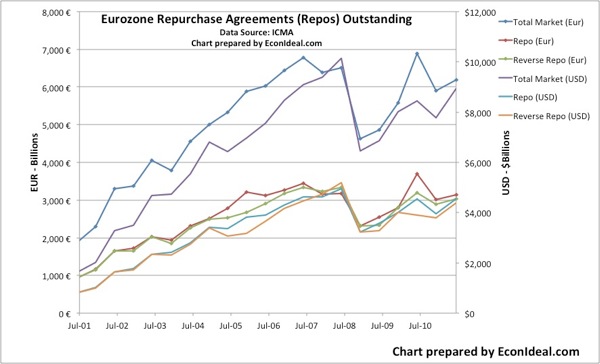
ICMA EurRepoSurvey Jun 01 Jun 11

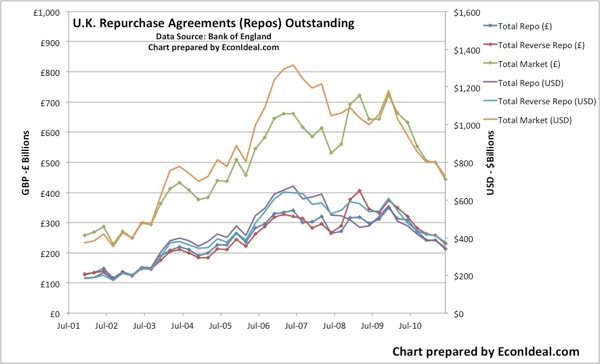
BoE repo Dec 01 Jun 11

SIFMA global cdo issuance

SIFMA MBSABS Issuance

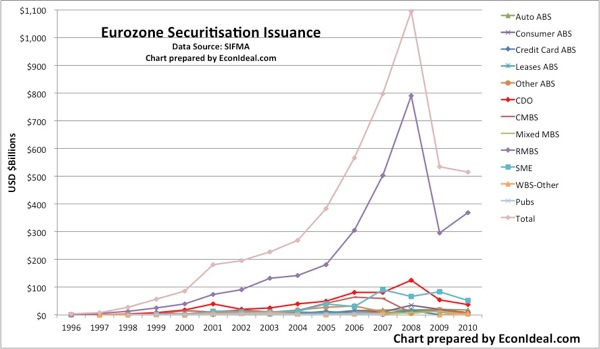
SIFMA Eur Securitisation Issuance

The repo markets are fueling the fires again.

Repurchase agreements ("repos") are the sale of securities combined with an agreement for the seller to buy back the securities at a later date, or a cash financing transaction combined with a forward contract. The duration of the agreement can be overnight, term or open. They are heavily used by investment firms to obtain short-term financing that can be rolled over; common financing aims are for longer-maturity, higher-yielding securities to juice the yield spread. Collateral for repo trades include sovereign debt (e.g., Treasuries), agency debt (e.g., Fannie/Freddie or GSE debt), or mortgage-backed securities (MBS). The Federal Reserve also uses repos to inject or withdraw money into/from bank reserves and the money supply, with Treasuries serving as usual collateral.

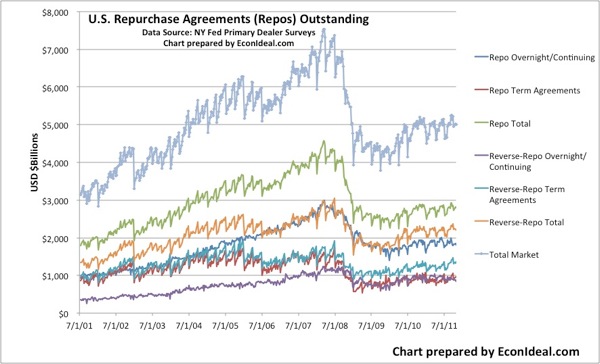
As the curves above show, the repo market size just among U.S. Primary Dealers had grown geometrically in the last decade, until choking following the 2007-8 credit markets seizure. It is worthwhile to note that the growth and decline of these markets correlates with the growth and decline of collateralized debt obligation (CDO) issuance, the same asset and mortgage-backed derivative security that provided a significant contribution to the counterparty risks leading to the credit markets seizure. CDOs were a structured hodgepodge of good and bad mortgage and asset-backed debt, and given a AAA rating from credit rating agencies, making them eligible as collateral for repo transactions, and attractive for their yield. When default rates picked up in 2006-7, the values of CDOs plummeted, and triggered a margin call nightmare that eventually doomed both Bear Stearns and Lehman. The fallout also affected AIG, who sold cheap CDO insurance in the form of credit default swaps (CDS) to CDO buyers, without recognizing the risks should those CDOs implode. The repo markets made most of this "Ponzi finance" of CDOs possible.

It may not be a surprise then that the recent failure of yet another large brokerage firm and primary dealer (MF Global) involved a sizable ($7.6B in March 2011) repo trade with European sovereign debt as collateral. Though MF Global structured the trade such that the maturity of the repo equaled the duration of the European bonds pledged as collateral, thereby seemingly reducing its duration mismatch risk, the firm off-loaded the collateral from its balance sheet as part of the accounting for the repo sale, and in doing so summarily avoided capital cushions to cover shortfalls should that debt lose value until maturity. As the Euro debt crisis heated up this fall, MF Global started getting a barrage of margin calls, then credit downgrades, and then more margin calls. It failed to survive this liquidity thrashing, seeking bankruptcy protection on Halloween. Lehman succumbed to similar fate, and has been accused of employing repo transactions as accounting maneuvers to manipulate its financial reports and leverage, using the funds from repo sales to temporarily pay down debt before repurchasing the collateral ("Repo 105").

To be sure, many repo transactions are used responsibly and legitimately, just as firms responsibly and legitimately use interest rate swaps to hedge interest rate risk. The problem arises when the underlying collateral of the repo trade sharply loses value, and the seller counterparty doesn't have enough capital to survive margin calls and credit downgrades.

The financial instability caused by the exploitation of the repo markets to finance the debt market growth cannot be overlooked, though regulators (Federal Reserve, SEC, et al.) have consistently ignored this major weak point. The worst manifestation of this systemic problem is when such debt market growth leads to "Ponzi finance," a term coined by Hyman Minsky in his classification of financial instability. It is so defined: "expected income flows will not even cover interest cost, so the firm must borrow more or sell off assets simply to service its debt. The hope is that either the market value of assets or income will rise enough to pay off interest and principal." This is precisely what occurred to mortgage and asset-backed debt during the housing boom-turned-bust, as subprime lenders accelerated their loans to unworthy borrowers and sold such bad debt en masse to MBS and CDO packagers/issuers. Those CDOs turned out to contain enough bad debt to invalidate their AAA rating — a rating issued on the faulty basis that default risks were spread out when super-packaged with "good" debt into a structured CDO.

Banks and investment houses still rely too much on repo lines to fund their spread bets (i.e., a lousy business model that just keeps on kicking despite the "systemic risk" and Ponzi finance potential). When the underlying collateral starts to smell, the markets start to seize, and central bank swap lines start to swing. The Eurozone repo market in particular as reported by ICMA declined less than the U.S. repo market and remained elevated after 2008 - and sovereign government and RMBS issuances in Europe increased (see above curves). As already discussed, the growth in the U.S. repo market before 2008 was correlated to the increase in CDO and MBS/ABS issuances, many loaded with subprime "II" junk. Meanwhile global debt outstanding keeps increasing at a record pace.

The opacity of the repo financing markets is an issue that regulators and industry both have failed to address. In particular, the Federal Reserve (specifically the NY Fed) has failed to provide adequate transparency to the U.S. markets, even though it is increasingly charged with regulatory powers that would cover these markets. The Basel Committee on Banking Supervision recently provided a case to strengthen repo clearing and a liquidity/capital framework but certain elements in the system (namely large dealers who want to maintain market share and certain capital terms to draw business) are bucking any changes or improvements that would seek to avoid market seizures and instabilities. Jamie Dimon's rant over the Basel solution is such an example, and JP Morgan has among the largest U.S. market share of the tri-party repo market. Granted, the Basel solution may not be the panacea, but a sensible capital and margin framework and a push to standardized clearing would go a long way, as would market transparency. JPM's role in the MF Global failure ought to be reviewed, no doubt. Let's not forget that JPM was also the repo banker of Lehman and Bear.

The derivatives markets also have suffered from opacity, but in recent years coverage has dramatically improved of both cleared and over-the-counter (OTC) derivative statistics, thanks to the Bank of International Settlements (BIS), DTCC, Tri-Optima, SIFMA, ISDA and other organizations and industry warehouses. In the case of repos, no organization tracks this market with the same level of detail; even accurate market size is not available from existing data [1]. DTCC has started to track a proprietary metric that measures the weighted average interest rate paid each day on General Collateral Finance (GCF) Repos based on U.S. government securities HERE, but not based on other collateral such as EU sovereigns, which has caused much recent consternation and contributed to the failure of MF Global.

Regulators and regulations were not the answer to the repo financing/debt market growth financial instability weak point. Regulators missed Lehman and they missed MF Global. Time after time, financial participants look to arbitrage (avoid) regulatory requirements through creative use of financial products and accounting, and they will continue to do so as avenues are closed, and others opened through "financial innovation" (and sheer desperation for yield and return). I submit that there are three solutions to mitigate this:

  • For industry and regulators to provide as much transparency of the repo, debt and derivatives markets as possible, so market participants can gauge exuberant growth and start to correct it through markets before unstable levels are reached;
  • Letting firms that abuse financing lines to juice yields or manipulate leverage and capital ratios FAIL, even if they are listed as "systemically important" or "too big to fail" — this will reduce moral hazard and force firms to consider consequences should they ignore prudent risk management or engage in fraudulent accounting;
  • Remove the Fed's mandate to control and fix interest rates, which in itself is a source of financial instability, as it leads to excessive endogenous money creation and speculation [2] — the thriving repo markets are but one symptom of this endogenous money activity.


[1] Sizing the vast repo markets is a challenge. The first step is to recognize who participates in these markets and what type of repo agreement those participants enter into. The participants include Fed-approved Primary Dealers (MF Global was one), the Fed itself, and non-Primary Dealers (bank holding companies, insurance companies, etc.). Agreements fall into two general categories: tri-party and bilateral. Tri-party agreements are mediated by a custodian bank or international clearing organization, which act as agents. In the U.S., JPM and Bank of NY Mellon are the major tri-party agents. Bilateral agreements are direct between the repo buyer and seller. The NY Fed provides data on repos between Primary Dealers, which includes its own repo activity HERE, the same as the data plotted at the top. The Fed's publicly available repo activity is broken out in the Fed's H.4.1 statistical release on factors affecting reserve balances, and is a fraction of the reported Primary Dealer activity. The M3 money supply metric, which the Fed used to publish but has discontinued, included its repo activity as well as interbank repo activity. The NY Fed has started to track tri-party repo activity HERE; this data includes both Primary Dealer and non-Primary Dealer participants. When I asked the NY Fed whether their tri-party data could be broken out into PD and non-PD buckets, they told me that this granularity was not available. I also asked the NY Fed for any data they had on repos between non-PD participants, most specifically bank holding companies. They told me that an aggregate was not publicly available through them, and indicated that they do not track such data. Instead they sent me a link to a website they maintain that contains thousands of quarterly reports on bank holding companies HERE, the National Information Center (NIC). When I asked the help desk at the NIC to advise on how to access aggregate data through this site, they responded that the NIC public website did not provide this service and advised me to "check with the Freedom of Information Act (FOIA) at http://www.state.gov/m/a/ips/." WOW. If our U.S. regulators are this lousy about tracking and releasing aggregate data, they are indeed impotent to prevent any financial instability! The reader may note that a true market size would include Primary Dealer and non-Primary Dealer, for both tri-party and bilateral agreements. A 2008 BIS report "Development in Repo Markets During Financial Turmoil" does publish data it was able to obtain on repo activity among some 1000 bank holding companies, and that market size is nearly 30% of the huge U.S. Primary Dealer repo market. Eurozone (non-UK) repo markets are tracked by ICMA HERE, and the Bank of England tracks UK repo markets HERE. To the regulators and industry: market participants and researchers are still waiting for a clean transparent total size of the repo markets. A breakdown of collateral, rates and maturities would also be (obviously) useful to track.

[2] See "Federal Reserve Capital Management," which includes a primer on endogenous money.

Thursday, September 15, 2011

Global Debt Watch: $95T and Counting

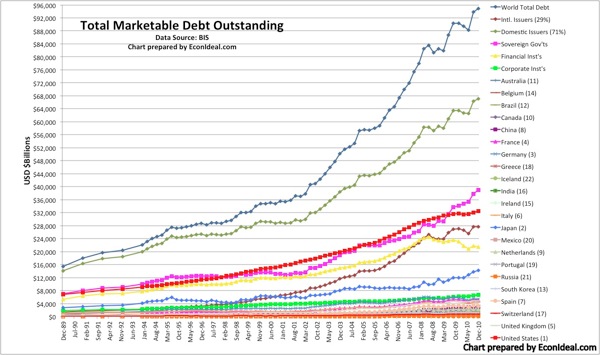
TotalMktDebt BIS Dec 89 Dec 10

As of Dec 2010, worldwide marketable/tradable debt outstanding neared some USD$95Trillion, according to the Bank of International Settlements (BIS). The historical data above indicates that debt markets have more than doubled from Dec 2002 to Dec 2010, with the largest increases stemming from domestic issuances, at first (2002-2007) from mortgage and asset-backed security issuances, and then more recently (since 2008), from sovereign government issuances. The United States maintains the largest debt market, at some $32.5T, ~35% of the worldwide total market [1].

Gauging and tracking marketable/tradable debt is key to understanding global capital market stability. Though total debt levels can also contain "nonmarketable" debt, such as nonmarketable sovereign government debt, it is the marketable debt that has the greater systemic influence across debt, equity and derivatives markets, since market participants price and trade that debt; however, the influence of nonmarketable debt levels should not be understated. I have started to maintain a "Global Debt Watch" page HERE, with the intent of providing historical trends and data analysis at regular intervals from a variety of international sources.

The fantastic growth in the debt markets has been assisted by three primary factors: (a) the reduced borrowing costs made possible by central bank monetary easing policies worldwide; (b) the aggressive use of short-term funding markets, such as the repurchase agreement (repo) and commercial paper (CP) markets, to borrow cash short and buy longer-dated, higher-yielding debt; (c) government policies that promote debt issuance, and government-sponsored entities (GSEs) that "back" such issuances. Government sanctioned credit rating agencies have also been a factor in the growth of debt markets.

The growth and decline of the repo and CP markets in the last decade coincide with that of the growth and decline of mortgage and asset-backed securities (MBS/ABS) and collateralized debt obligations (CDOs), structured pools of MBS/ABS. The total repo market size between the two largest markets, U.S. and Europe, stood at approximately $12.6T Dec 2010, after falling from a 2008 high of $17.5T [2]. Unlike the CP markets, the repo markets are not reported in the BIS debt data above; repo markets are (usually) very fluid, with the majority of transactions composed of overnight or very short-term maturities. The relative opacity of repo markets, plus their vulnerability to liquidity issues due to collateral quality, counterparty risk and capital cushions, make tracking these markets imperative to gauging stability and "systemic risk." Conceivably, the more transparency in the repo markets, the better able the system would be to handling (greater) market liquidity dislocations, such as that experienced from the credit crisis of 2007/8. However, such transparency does not solve the problem of debt accumulation sponsored by central bank monetary and sovereign government fiscal policies.

[1] The Securities Industry and Financial Markets Assoc. (SIFMA) estimates U.S. debt markets at $35.5T, ~37% of the total worldwide market. SIFMA includes offshore centers and CDOs issued in USD.
[2] I assembled these estimates from two sources, the NY Federal Reserve (Fed) and the International Capital Market Association (ICMA). The NY Fed data only reports primary dealer repos, from a survey of Fed primary dealers, and does not count private OTC repos handled by bank holding companies. That may likely increase the U.S. total by some 30%, according to BIS.


Saturday, August 13, 2011

Vintage Greenspan and the Lessons of LTCM

"There are some who would argue that the role of the bank supervisor is to minimize or even eliminate bank failure; but this view is mistaken, in my judgment. The willingness to take risk is essential to the growth of a free market economy...[I]f all savers and their financial intermediaries invested only in risk-free assets, the potential for business growth would never be realized." –Alan Greenspan, November 1994 [1]

In reviewing these words from "the maestro," one gets an insight into the mind of Federal Reserve (Fed) actions from 1994 to 2008, in particular the dichotomies that promoted risk-taking and investment-driven growth, yet allowed for the rise of moral hazard. In driving an environment of increasingly low interest rates through easy monetary policy, Greenspan manipulated market driven risk-reward and ignited a series of rallies and crashes in the bond and stock markets that distorted normal capital market function.

The private hedge fund Long Term Capital Management (LTCM), one of the first major casualties of the 1998 global bond and stock market swoons, had bet a near 100-to-1 leverage on a risky portfolio mix of directional trades, bond arbitrages, swaps and equity volatility shorts [2]. Though LTCM thought it was "diversified" and "hedged" according to its academic models, it was anything but, placing large bets in markets that became distorted by its very presence and dislocated when the selling started; it didn't help that instead of an early divestiture of a portion of its holdings and a decrease in leverage, LTCM doubled down, falling for the Casanova's Martingale, a betting scheme that provides an eventual win as long as there is enough capital to keep doubling the stake.

After a Fed-orchestrated bailout of LTCM by a plethora of Wall Street firms that had lent LTCM money, had been its counterparty or investment partner, a Fed official issued a telling statement that was ignored by the banking establishment, the Fed and regulators as a whole thereafter:

"LTCM appears to have received very generous credit terms even though it took an exceptional degree of risk...Counterparties obtained information from LTCM that indicated that it had securities and derivative positions that were very large relative to its capital. However, few, if any, seem to have really understood LTCM's risk profile, especially its very large positions in certain illiquid markets. Instead, they appear to have made credit decisions primarily on the basis of LTCM's past performance and the reputation of its partners. LTCM's counterparties...required little or no collateral to cover the potential for future increases in exposures from changes in market values...[and] appear to have significantly underestimated those potential future exposures. Their estimates simply did not make adequate allowance for the extreme volatility and illiquidity of financial markets that surfaced in August and September [1998]. Furthermore, they failed to take into account the potential for credit exposures to increase dramatically if LTCM had defaulted and they and other counterparties had attempted to liquidate collateral and replace derivatives contracts in amounts that in some instances would have been very large relative to the liquidity of the markets in which the transactions would have been executed. Because the counterparties did not take these risks into account, they granted LTCM huge trading lines in a variety of products, and LTCM took advantage of those lines to achieve its exceptional degree of leverage." [3]

The December 1998 testimony in [3] goes on to offer numerous recommendations on risk management and prudential oversight, and in particular on OTC derivatives. Yet this working group and its findings were largely ignored, LTCM bailed out, and the easy credit-moral hazard derby in play.

In bailing out LTCM, major Wall Street firms (Goldman, J.P. Morgan, Merrill, Chase, Salomon, Lehman, plus a number of foreign creditors) agreed to a settlement that would provide in excess of some $4B to cover LTCM's losses, in large part to cover counterparty exposure and to prevent further losses among the counterparties that lent LTCM money or invested with LTCM. On the seemingly positive side, it was the Street and not the Fed that would provide the bailout, but this is not entirely true. After LTCM's failure, the Fed embarked on a series of interest rate cuts to ease jittered markets affected by LTCM's failing positions and hit with the contagion fear of LTCM's fate. The Fed was now catering to the idea of staunching what it thought was systemic risk with monetary intervention, and thereby providing a market-wide bailout.

A decade later, Bear Stearns (LTCM's clearing broker) would experience a more massive failure fate from subsisting on repurchase agreements (repos) and additional short-term funding obtained on favorable credit terms from JPM and other lenders to double down on mortgage debt and derivatives. Bear, like LTCM, thought it was diversified and hedged, when it was anything but, and instead of reducing leverage and positions it too doubled down, especially on securitized mortgage debt (CDOs, or collateralized debt obligations) that it thought could recover in value. When Bear could not sell such illiquid CDOs in an increasingly hostile market, and when its capital positions withered along with its credit lines, Bear received a Fed-orchestrated bailout by JPM, except this time taxpayers received exposure via a $30B backstop from the Fed of increasingly toxic mortgage debt instruments.

Within 6 months, AIG would receive a direct $85B bailout (and later over $100B more) from the Fed, for much the same serial infraction of risk taking as LTCM and Bear. AIG would extend CDO insurance (in the form of credit default swaps or CDSs) to Société Générale, Goldman, Merrill, Deutsche Bank, and many other firms that invested long in the CDO market, without anywhere near the proper capital to cover losses from CDO defaults, should they occur (and they did, en masse, in tail risk fashion). Lehman, like Bear, relied on repo lines and the commercial paper markets to fund its Martingales on CDOs and off-balance-sheet entities such as structured investment vehicles (SIVs) that in turn invested in CDOs to get around regulated capital requirements. Though Lehman succumbed to bankruptcy fate instead of a Fed/Street bailout, Citigroup and Merrill would receive large infusions from the Fed and Treasury, with Merrill taken over by Bank of America.

Many financial pundits today blame the November 1999 repeal of the Glass-Steagall (G-S) Act as the cause of exploding risk taking and moral hazard stemming from systemic risk among large financial institutions. I disagree. In parsing the history of LTCM's failure (which occurred well before G-S was repealed) and the Fed's summary monetary policy response, we didn't need a repeal of G-S to set the stage for exploding risk and moral hazard. The Fed provided plenty of fuel in its cheap money policy for firms to borrow short on cheap terms and invest leveraged long in highly risky assets for their carry interest. Regulation and regulators are obviously not the panacea here. Government needs to quit rewarding moral hazard, to allow firms to fail, and to not intervene with monetary policy bailouts to markets. Financial firms will then get the idea that risk taking does indeed require prudential management and oversight. Business investors in the main who are willing to take on the calculated risks that Greenspan called "essential to the growth of a free market, capitalist economy" know, accept and manage such risks, otherwise they are out of business.

[1] "The New Risk Management Tools in Banking," Alan Greenspan, Address to the Garn Institute of Finance, University of Utah, November 20, 1994. Everyone should read this address, which contains some very persuasive arguments. The tragedy is the actual history that followed, negating Greenspan's credibility. 
[2] Two outstanding books that have documented the rise and fall of LTCM are of note: (a) "When Genius Failed," Roger Lowenstein, c.2000; (b) "Inventing Money," Nicolas Dunbar, c.2000. 
[3] Testimony of Patrick M. Parkinson, Associate Director, Division of Research and Statistics of the Federal Reserve Board, Progress report by the President's Working Group on Financial Markets, Before the Committee on Agriculture, Nutrition, and Forestry, U.S. Senate, December 16, 1998.